
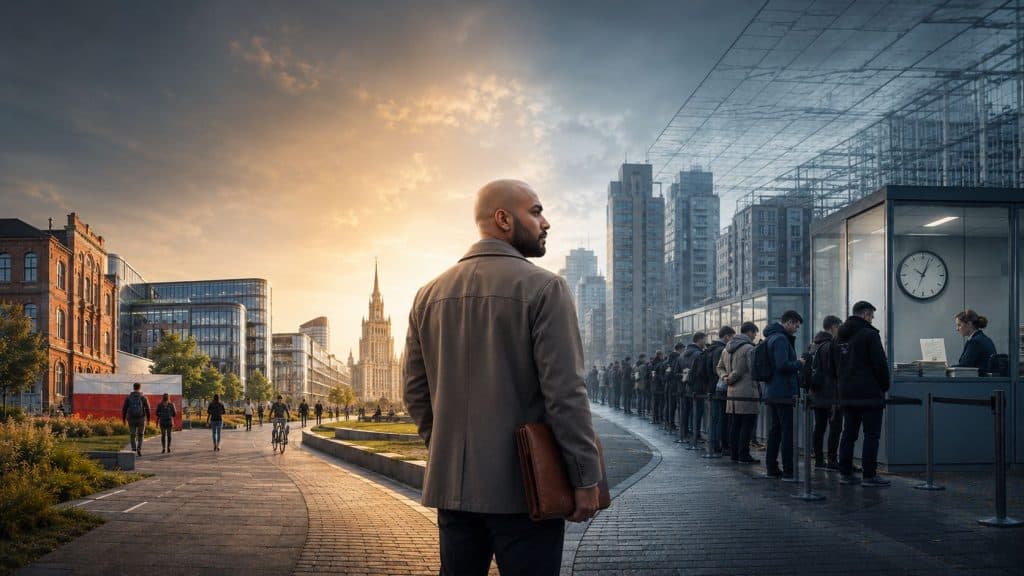
An opinion piece based on personal experience living, studying, and working in Poland since 2017.
Introduction
This article will not be popular. I know many people online promote Poland as a rising European success story. Some call it Europe’s hidden gem. Others use slogans such as “Be Like Poland” and present it as a model country because it is relatively safe, clean, conservative, and has experienced strong economic growth. I disagree with much of that narrative.
My perspective comes from nearly a decade of living in Poland, having also lived in Scotland, England, and France, and travelled across more than twenty countries. I completed my master’s degree here, worked for multinational companies, paid taxes, and built a life. Beyond this personal journey, my insights are shaped by extensive professional experience in international education and global career mobility. I have served as an international representative for various British universities, worked as a campus ambassador for prominent portals like Studyportals, and collaborated on cross-continental projects with organizations such as ‘X-Culture’ spanning the USA, Asia, and Europe. Furthermore, I ran a successful YouTube channel dedicated to studying abroad, where I guided countless genuine students through complex international academic and career pathways. This multifaceted background provides a unique lens through which to analyze the opportunities and challenges faced by non-EU professionals in Poland and, by extension, West & Europe.
My conclusion is simple: If you are a high-value, genuine legal, highly ambitious, and meritorious non-white professional seeking to build a truly global career and be judged primarily on merit, Poland may not be the opportunity many people think it is. Furthermore, from an investment perspective, the current socio-economic and political climate suggests that it may not be a prudent place to commit significant capital or long-term career prospects. This is not because Poland has no positives. It does. The problem is that the marketing and reality are often very different.
The Poland You See Online Is Not Always the Poland You Experience
A large part of Poland’s international reputation today is built on social media narratives. The message is simple: Poland is safe, clean, has fewer immigration problems than some Western European countries, is growing economically, and is conservative and Christian. For some audiences, especially those frustrated with developments in Western Europe, this image is extremely attractive. This is where the “Be Like Poland” narrative comes from.
However, what many people fail to mention is that Poland’s current position is very recent. For generations, Poland was not viewed as a model. Millions of Poles left the country searching for opportunities abroad. Polish workers migrated to the United Kingdom, Germany, Ireland, France, and elsewhere because economic opportunities at home were limited. Poland was whiter, more Christian, more conservative, and more European in the past, no? If Poland had been such a perfect model for decades, why did so many people leave? That question is rarely asked.
My own journey to Poland in 2017 exemplifies this shift. At the time, Poland was an absolute unknown destination for many international students and professionals. Yet, Polish universities, often supported by European Union initiatives, began aggressive recruitment and marketing campaigns. Programs like “Study in Poland” and “Poland My First Choice” were instrumental in attracting foreign talent, highlighting affordability and a European lifestyle. These efforts, coupled with EU-funded programs such as Erasmus+, played a significant role in internationalizing Polish higher education and drawing individuals like myself to its shores.
Poland’s Success Did Not Happen in Isolation
One of the biggest myths is that Poland’s growth happened entirely because of cultural superiority or some unique national formula. The reality is much more practical. Poland benefited enormously from European Union integration. It benefited from access to European markets. It benefited from foreign investment. It benefited from multinational corporations opening operations in the country. It benefited from skilled immigrants from various countries. It benefited from openness to global business. It benefited from European funding programs. These factors played a major role in transforming the country. Yet some public narratives today act as if Poland succeeded despite international cooperation rather than because of it. That is historically inaccurate.
Poland has transitioned from a country of net emigration to one of net immigration. In 2024, Poland issued approximately 488,848 first residence permits to non-EU nationals, a decrease from previous years but still a substantial number. The number of foreign workers in Poland has steadily risen, reaching 1.14 million in 2026. This influx of global talent has been crucial for Poland’s economic development, filling critical labor gaps and driving innovation across various sectors. However, it is essential to recognize that these high-value individuals are not merely “contributing” to a host nation; they are making strategic decisions about where to invest their expertise, time, and capital. Countries and universities globally compete for this demographic, and the onus is on the destination to prove it is worthy of such investment.
From a business perspective, the “Polish Miracle” is heavily anchored in Foreign Direct Investment (FDI). In 2022, FDI inflows peaked at $41.78 billion before settling into a more volatile pattern, with Mar 2026 seeing a modest increase of $2.2 billion. While the government has made the FDI regime permanent to signal stability, the underlying data reveals a concentration in low-to-mid-value manufacturing and service centers rather than high-end R&D. For the ambitious professional, this means the “growth” they see in headlines often translates to a corporate landscape dominated by back-office operations where the ceiling for advancement is lower than in global innovation hubs.
The Polish Economy Is Often Overrated
Yes, Poland has grown. But growth alone does not tell the whole story. Many foreigners arrive expecting extraordinary opportunities. Instead, they discover a more complicated reality. There are good jobs, especially in technology, finance, engineering, and multinational corporations. But there are also many low-quality jobs with salaries that do not always match rising living costs. Housing prices have increased dramatically. Rent has become expensive. Property prices in major cities often appear disconnected from local purchasing power. Inflation has also affected daily life. For highly skilled professionals comparing Poland against global alternatives, the value proposition is not always as attractive as online promoters suggest. The question should not be: “Is Poland growing?” The question should be: “Is Poland the best place for ambitious global talent?” Those are very different questions
The Vanishing Affordability: Tuition Fees and Living Expenses
One of Poland’s initial appeals, particularly for international students and young professionals, was its perceived affordability. Unlike other Western countries like the UK, Australia, and Canada, Poland did not exploit international students and used them as cash cows. However, this advantage has significantly eroded over recent years. Tuition fees, once a fraction of those in Western Europe, have seen substantial increases, with universities manipulating and hiking charges. Similarly, the cost of living, especially in major cities, has skyrocketed. Rent, daily necessities, and services are no longer as cheap as they once were, making the financial burden on students and professionals much heavier. If the current tuition fees and living expenses had been in place in 2017, when many, including myself, considered Poland, it would likely not have been a viable or attractive option. This erosion of affordability fundamentally alters Poland’s value proposition, pushing ambitious individuals to seek alternatives where their investment in education and living translates into a more sustainable and rewarding experience.
The Bureaucracy & Immigration Procedures Send the Wrong Message
This is one of my biggest criticisms. A country that claims to want skilled foreign professionals should treat them accordingly. Too often, that does not happen. Many non-EU residents experience long waiting times for residence permits and renewals. Some people wait many months. Some wait more than a year. Some experience uncertainty that affects employment, travel, business planning, and personal stability. Imagine strategically choosing to study in the country, bringing your high-demand skills to the workforce, injecting capital through taxes and consumption, and adhering to every legal requirement, only to be left waiting for over a year for administrative decisions. The message this sends is simple: “We will take your economic input, but we will not respect your time or status.” For a high-value professional who has the agency to move anywhere in the world, this level of bureaucratic disrespect is not just an inconvenience; it is a clear signal to take their talents and investments elsewhere. Imagine needing to renew your residence permit, only to find out that you may have to wait 1.5 to 2 years to receive the new card. In the meantime, you may not be able to travel outside Poland. Horrible.
To make matters even more interesting, a white European who came to Poland from another country to work told me that perhaps Poland is passively trying to signal to foreigners that they are not wanted here.
Imagine the sheer arrogance and self-indulgent hypocrisy behind that mindset: the idea that Poland and other European countries are somehow doing charity work for non-white people from poorer parts of the world. That mentality is what actually reflects a form of Western white supremacy. And it is not limited to people you might expect to find on the streets. You can encounter it even among highly educated corporate professionals.
What is particularly striking is that this mindset seems completely disconnected from the realities of global mobility, internationalisation, and how modern economies actually function.
And even if, hypothetically, Poland really were deliberately creating these delays to discourage foreigners from staying, that would only prove my point: do not invest in Poland.
In addition to the third-world-level immigration office work outlined above, Poland is becoming an unattractive place for long-term residence, permanent residence, and citizenship in 2026/2027. Until recently, Poland marketed an immigration policy that allowed foreign graduates and professionals to obtain permanent residence and, eventually, citizenship after five years of paying taxes. However, the law has been changing dramatically, creating a sense that a political game is being played.
It would be a horrible investment of your time, career, and capital to build your future in a country that does not offer a great ROI. It is better to invest your time, money, and career elsewhere.
The New Money Problem
This section may be uncomfortable, but it needs to be discussed. Poland’s economic rise is relatively recent. With new prosperity sometimes comes new arrogance. I have observed individuals who speak as if Poland has always been a wealthy and globally dominant country. That is simply not true. Economic success should create confidence. It should not create superiority complexes. Some people forget that only a generation ago many Polish families were seeking opportunities elsewhere. Now there are voices lecturing immigrants while forgetting that migration played a major role in Poland’s own history. This contradiction is difficult to ignore.
The ‘Conservative Haven’ Trap: Western European Populists in Poland
Adding another layer of complexity is the recent influx of Western European & American populists and soft/hard supremacists into Poland. These individuals, often from countries with long colonial histories and complex immigration backgrounds, arrive with a preconceived notion of “low-class migration” & ”social segregation” in their home nations. They frequently perceive themselves as inherently superior to non-EU, non-white migrants in Poland, often due to shared Christian, white, and European identities. This phenomenon, driven by the rise of European populism, means that these individuals bring their prejudiced mentalities into the global working environment in Poland. This creates an atmosphere of insecurity, passive racism, and condescending behavior, further marginalizing non-white professionals. This dynamic adds a unique challenge: segregation and hostility.
The Social Cohesion Mirage: Why Poland’s Future is Precarious
Highly ambitious individuals often seek destinations that offer a high quality of life, a superior standard of living, and a genuinely open society. However, the future trajectory of Poland, particularly concerning its approach to immigration, raises concerns that it might replicate the social cohesion failures observed in other European nations. The rapid influx of migrants, including Ukrainian refugees, downhill Western European economic migrants, coupled with insufficient integration policies and rising populist sentiments, risks creating societal divisions. This can undermine the very qualities that attract skilled professionals, leading to a decline in the perceived openness and stability of the society. The danger lies in a potential future where the social fabric frays, making it an increasingly less attractive destination for those prioritizing long-term stability and genuine integration.
The Productivity-Pay Gap and Corporate Governance
A core theme we decode at Business Cipher is the relationship between labor productivity and compensation. In Poland, while corporate sector wages rose 5.4% year-on-year to PLN 9,530.74 in April 2026, they consistently fall short of market expectations and the real growth in productivity. This “productivity-pay gap” suggests that while professionals are working harder and more efficiently, the financial rewards are being disproportionately captured by corporate entities rather than the talent itself.
Furthermore, corporate governance in Poland remains largely conservative and resistant to diversity. Recent studies on board diversity policies in Polish listed companies reveal a significant lack of inclusion, with many corporate boards remaining homogenous and resistant to non-traditional talent. For a highly ambitious non-EU professional, this represents a “glass ceiling” that is not just social, but institutional. Without a robust commitment to diversity in leadership, non-white professionals often find their career trajectories capped, regardless of their merit or contribution to the company’s bottom line. This lack of institutional evolution is a critical risk factor for anyone looking to build a long-term executive career in the region.
The Hypocrisy of European Liberalism
Another point of contention is the often-hypocritical stance of what can be termed “European liberal science” or populist leftist ideologies. While outwardly advocating for diversity and inclusion, these narratives can inadvertently foster insecurity among certain segments of the native population. When individuals feel their own poor education, lack of skills, or perceived evolutionary stagnation is being highlighted or threatened, they may lash out. This insecurity is then often unfairly targeted at immigrants, who become convenient scapegoats for deeper societal issues. This dynamic creates a toxic environment where immigrants, regardless of their quality, are viewed with suspicion and resentment, further complicating the path to genuine integration and acceptance. The perceived moral superiority of some liberal discourses can, paradoxically, exacerbate social tensions and fuel anti-immigrant sentiments among those who feel left behind or misunderstood.
From Victim to Perpetrator: Lessons from the UK
My observations during my bachelor’s studies in Scotland and England provided a stark illustration of how migration dynamics can breed resentment and discrimination. It was striking to witness the pervasive presence of Polish people across various sectors, despite Poland not having a historical colonial tie to Britain. This visibility, however, often came with a downside. I frequently observed instances where native British individuals looked down upon Polish immigrants. There were even shocking occasions in my classes where verbal arguments erupted between Polish immigrant students and native British students, sometimes in the presence of teachers. This experience highlighted a profound anti-Polish sentiment, demonstrating how quickly newcomers, even from within Europe, can become targets of prejudice when perceived as a threat or simply “different.” This personal history underscores a critical irony: those who might have faced similar forms of racism and condescension in Western Europe could, consciously or unconsciously, contribute to a similar environment for non-white immigrants in Poland. It reveals a cyclical nature of prejudice, where past victims can become unwitting participants in new forms of discrimination.
Living as a Non-White Professional: The Disgraceful
This section is more about European Populism & supremacy, and less about Poland.
Experiences vary. Some people report no problems. Others report significant challenges. My view is that high-value, meritorious non-white professionals, who are globally sought-after, should not blindly assume that integration will be easy. Poland remains far less diverse than many countries. As a result, these professionals can attract attention simply because they look different (Good & Bad). While many interactions may be neutral, and some individuals friendly, there are also moments that can make them feel like permanent outsiders. The issue is not always open hostility; sometimes it is subtle social exclusion, assumptions, or simply being non-white & non-EU expats; they will never be viewed as fully belonging. For individuals whose skills and expertise are in high demand worldwide, this is not only exhausting-it is a significant disincentive to commit their valuable time and talent to such an environment.
There is a particularly disgraceful narrative that has emerged in public discourse, often using phrases like “lekarze i inżynierowie” (doctors and engineers) in a derogatory or sarcastic manner. This phrase is frequently employed to dismiss the qualifications and aspirations of non-white immigrants, implying they are not genuinely skilled professionals despite their claims. The irony is that many individuals who were rightfully attracted to Poland, often through the very recruitment efforts mentioned earlier, did become doctors, engineers, and corporate professionals. They achieved this by proving their merit against a backdrop of prejudice. This narrative not only attempts to devalue their inherent worth and strategic choice to be in Poland but also perpetuates a harmful stereotype that fundamentally misunderstands the global talent market. It undermines the immense potential that diverse, high-value professionals bring, not as mere contributors, but as drivers of innovation and economic growth who have chosen to deploy their capabilities in a specific location.
The “Be Like Poland” Narrative Has Serious Blind Spots
I understand some parts of the argument. Countries should control borders. Countries should have immigration systems. Countries should encourage integration. These are reasonable positions. What I reject is when the slogan becomes a vehicle for ethnic superiority, cultural arrogance, or simplistic narratives. A successful country is not defined by how few foreigners it has. A successful country is defined by how effectively it creates opportunity, attracts talent, rewards contribution, and builds a functioning society. Those are different standards.
Christian Fundamentalism and its Impact
Another critical aspect often overlooked is the influence of Christian fundamentalism on Poland’s social and political landscape, particularly concerning immigration. Their influence contributes to an environment where non-white and non-Christian immigrants may face additional layers of scrutiny and prejudice, further reinforcing the feeling of being an outsider. This ideological stance, while rooted in certain religious beliefs, can inadvertently fuel discriminatory attitudes and practices against those perceived as culturally or religiously different.
Future Risks of Being an Expat in Poland
Poland faces a demographic challenge. The population is aging. Many sectors need workers. The current rise in Economic growth will require people, skill sets, and a continuous injection of capital. Investment requires people. Businesses require people. That means immigration will likely remain necessary. At the same time, anti-immigration sentiment remains influential in parts of public discourse. This creates tension. The economy needs workers. Parts of society resist newcomers. That contradiction may become more visible in the future. If social tensions increase, ambitious foreigners may find themselves caught in the middle. In addition, if Poland follows the same trajectory as other European countries, where society becomes increasingly divided between locals and migrants, it risks creating a form of segregation rather than genuine integration.
If multiculturalism is approached without meaningful, actionable efforts to integrate people into European cultural and social norms, Poland could eventually lose some of the very cultural character that attracted people like me in the first place.
A country can become less attractive to international talent precisely by failing to preserve and integrate the cultural and social environment that made it attractive to begin with.
The Reality Behind the European Civilization Myth
Another lesson I learned is that economic development and sophistication are not the same thing. Some people assume that in so-called developed & civilized Europe, the population automatically possesses exceptional global awareness. Reality is more complicated. There are highly informed people. There are highly educated people (not talking about certified education). There are internationally minded people. But there are also people with limited understanding of immigration systems, international mobility, global economics, or life outside their immediate environment. This is not unique to Poland. This is about primal human behaviour, ignorance, hypocrisy, and strange European white cultism. It exists across many countries. The difference is that Europe is often marketed as a pinnacle of civilization, progress, and enlightenment. The reality is more human. People everywhere can be informed, uninformed, open-minded, or closed-minded.
What Poland Gets Right
Poland has strengths. It is relatively safe. Many cities are clean. The startup ecosystem has improved. There are talented entrepreneurs. There are excellent engineers. There are hardworking professionals. There are genuinely kind and welcoming people. I have met many of them. Poland had an immigration system that attracted the right people. Poland did not have an exploitative system to extract foreign capital. Poland does not have a history of invading other countries and forcing their culture. Poland has amazing natural places to visit; it has been an underrated tourist destination. Poland’s progress is real. My criticism is not that Poland has failed. My criticism is that many people exaggerate its success while ignoring its weaknesses. Most importantly, whether in 2026/2027, Poland is a place for non-white non-EU students and professionals to invest their time, career, and money?
Final Thoughts
If you are a highly ambitious doctor, engineer, entrepreneur, executive, researcher, or business professional from outside the European Union and non-white, I would encourage you to think carefully before relocating to Poland/Europe. Do not rely on social media. Do not rely on political narratives. Do not rely on slogans. Visit. Research. Speak to immigrants. Speak to locals. Speak to people who have lived there for years. Then decide. Poland is not the disaster some critics claim. But it is also not the flawless success story many supporters promote. The truth, as usual, lies somewhere in between.
My personal conclusion after years of living, studying, working, and paying taxes in Poland is that highly ambitious global talent should look beyond the marketing and evaluate whether the country’s social environment, bureaucracy, and long-term trajectory truly match their goals.
In my next article, I will delve deeper into the pervasive insecurity, passive racism, and condescending environment that often characterize the experience of non-EU professionals across Europe, arguing why they should entirely avoid the continent. I will also lay out the abhorrent Immigration exploitation that Western countries undertake to pump up their economy when needed & during economic downturns, but use valuable brains as cash cows and political pawns later.
Summary of personal thoughts: If you do not want immigrants or people of a certain background – What or who is stopping you from closing down your visa service, consulate, and immigration route? Stop marketing, stop recruiting, and stop outreaching.
If you, on the other hand, want immigrants, then make sure to acknowledge the need, respect merit, and create a welcoming environment. It is also recommended not to take a page out of other countries that exploit, rig, chop/change the system for economic and political benefit.
For more analysis of global career and investment decisions, explore the Business Cipher blog.

Mortuza Reza is a business and technology researcher with an academic background in International Business and interests spanning finance, investment, wealth, AI, emerging technologies, and the digital economy. At Business Cipher, he explores business trends, financial markets, technological innovation, and the forces shaping the future of the global economy.